The Adversity of U.S. Startups and the Argentinian Hero
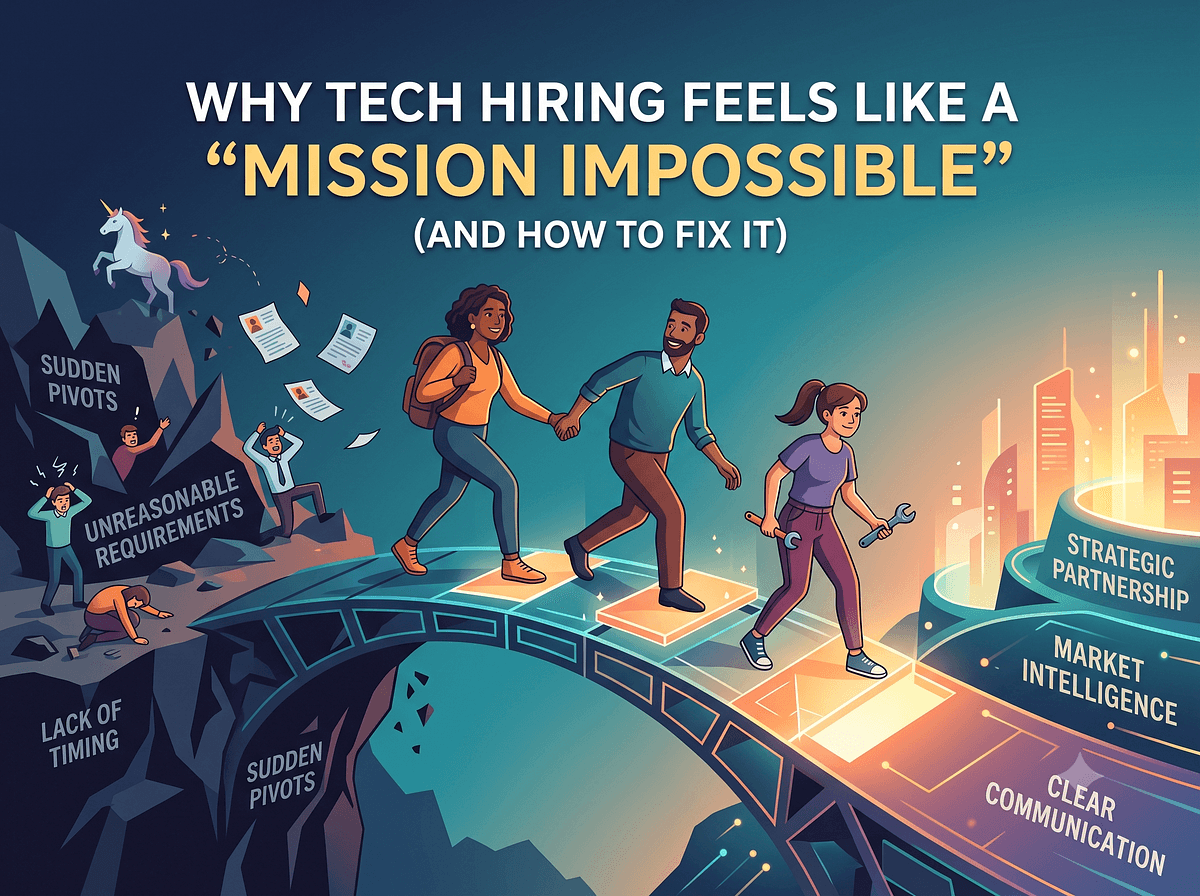
Imagine your startup is a high-end restaurant, but with a peculiar twist: the management demands that you change the menu and ingredients every week. On Monday, you design an avant-garde dish (a new feature); on Thursday, they ask you to simplify it to the extreme to save costs; and on Friday, the boss decides the specialty is now vegan food. You cannot operate with fixed manuals. You have to improvise and redesign the entire kitchen while customers are at the tables, dealing with unstable suppliers and impossible deadlines.
This is the reality of tech leadership today: the market forces you to be the chef who adjusts the recipe in real-time, grappling with the scarcity of talent that possesses the Operational Resilience to deliver results under adverse scenarios. It’s not just about the ability to cook; it’s about the tenacity to remain calm when the business has to drastically change its focus.
How do you build a sustainable business when the only constant is change? But the irony lies in the fact that the solution to this scarcity is not found in order, but in chaos. The global market has, until now, ignored an entire culture that has been in continuous survival training. I’m talking about Argentina, where crises are not anomalous events, but the operational condition of professional life.
When Chaos Becomes a Competitive Advantage
Argentina’s macroeconomic instability is a high, furious tide that arrives every few years, but whose residual waves never fully recede. Far from paralyzing, it forced long-term planning to become agile and compelled a mental urgency focused on immediate problem-solving and resource optimization.
Professionals were forced to “do more with less.” If we continue with our culinary analogy, they didn’t just have to change the menu: they had to create five-star dishes with three ingredients. It wasn’t about innovating for pleasure, but innovating to survive. This field experience has developed a shrewdness and a capacity for improvising solutions that distinguishes them. They are the type of chef who, when a key ingredient (or an essential resource) runs out, replaces it with ingenuity without the customer noticing the difference.
A Proven New Talent Model
Argentina is the second country in Latin America with more than twelve unicorn companies. They are “true talent academies” that have trained thousands of professionals in global-scale project management, complex infrastructure, and agile methodologies. Hiring an engineer from this ecosystem is hiring someone who has already gone through the vetting of international best practices.
Additionally, Argentina leads the EF English Proficiency Index in Latin America with a “high skills” level. This minimizes communication friction, a common issue in offshore hiring.
Furthermore, there is an almost perfect time synchronization with the United States, which allows for real-time collaboration, accelerating development cycles and instant feedback: something essential in Agile methodologies.
Empowering Your Crisis-Solver
For the U.S. CTO, capitalizing on this talent demands a shift in role: from Supervisor to Mentor:
The Argentinian professional excels in their “shrewdness” and proactivity. Assign the complex problem. Set aside micromanagement. This maximizes innovative output without the need for constant supervision.
The benefit is palpable: by investing in Argentinian tech talent, you are hiring quality for a fraction of the cost of the West Coast, and operational risk is reduced with a team that is not afraid of complexity. You are buying resilience.
This is the portrait of the Argentinian professional: They are not the cook who only functions with the strict recipe and measured ingredients; they are the executive chef who improvises the menu with what they have available. They are the committed professionals whose greatest virtue is their ability to transform adversity into opportunity.
Are you ready to meet a pool of crisis-solver talent? Contact us to meet highly specialized talent from Argentina and the rest of LATAM.
In your experience, what is the most underestimated soft skill you have found in a developer?